A research library anyone can question
One workflow reads the papers and the data together and cites every claim back to its source.
The problem
Why this work is slow today.
A research collection holds papers, course materials, and project data in different places. A question that spans them takes a specialist and an afternoon.
In the demo
What you see, step by step.
One query, many readers
The workflow fans out across the whole collection at once.
Data and documents together
One step answers from the spreadsheets. Others read each paper in the library.
Analysts and a synthesizer
Analyst steps work the question against the documents. A synthesizer gathers every result into one answer.
Published as an app
The workflow becomes an assistant with a description, so anyone opening it knows what to ask.
The result
What changes for your team.
The assistant answers paper by paper with titles, authors, and years. It cites every claim, sets results side by side, and states the limitations alongside them.
Who it fits
Universities and institutes
Libraries and research offices with large collections.
R&D groups
Teams that need answers across past studies.
Policy researchers
Analysts who must show their sources.
Transcript
The narration, in full.
This Workflow AI use case turns an academic database into a research assistant anyone can question. Every run starts at the User Input node. It is the bridge between the user and the workflow. Whatever someone types on the front end is fed in here and passed to every node that follows. From that one query, the workflow fans out across the whole collection at once.
Academic Data Search reads the spreadsheets, course materials, research projects, and the research repository, and answers against them in plain language. Alongside it, a chat node is pointed at each paper in the library, from machine learning and research methodology to institutional ethics and cybersecurity. Analyst nodes take that same query and work it against the documents, with the temperature kept low so the answers stay precise.
A synthesizer gathers every result into one answer. 9 nodes, 1 question, and every one of them reports success. Appify then turns the workflow into an app, so users engage with it directly, and with all the data behind it. First, the app type. A chatbot app needs a workflow that starts with a user input node, and it keeps the conversation history.
Then the nodes whose results should be visible in the app, and a description so anyone opening it knows what to ask. The app is published and sits in apps, ready to use. Ask it for an overall summary of the database. It answers paper by paper with titles, authors, publication years, and keywords, and cites every claim back to its page and chunk.
It sets model results side by side and states the limitations alongside them. Ask something different, on the ethics of the research process, and the same workflow answers from the same sources. One workflow, one query, and a whole database a question away.
This demo is produced by ICS Nett and shows FinBlade AI running on sample data. Company names, people, and figures are illustrative. Your deployment runs on your own data, inside your own boundary.
Keep watching
Related demos.
 1:32
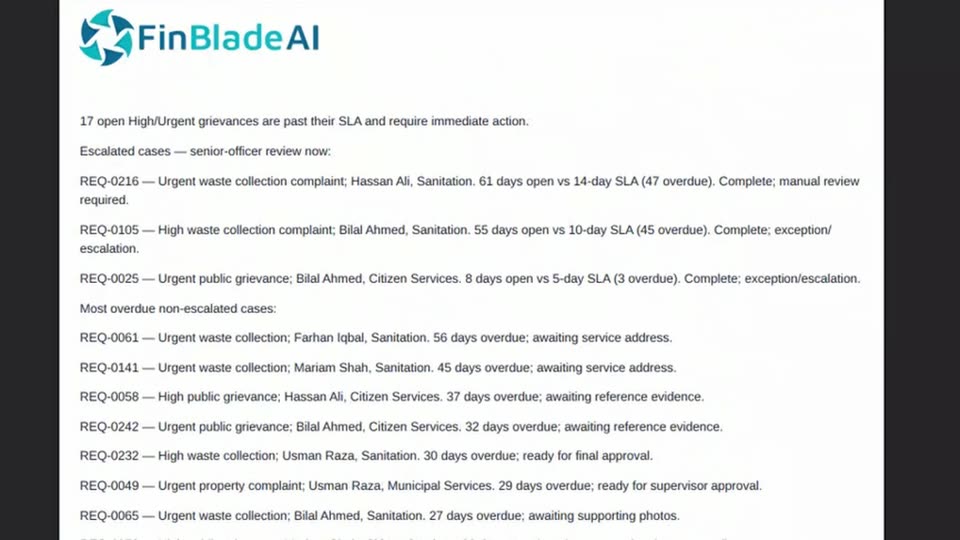
Public sectorCitizen requests, from complaint to decision letterThe agent finds overdue cases, routes each one to approve, request information, or escalate, and sends the right document.
 1:55
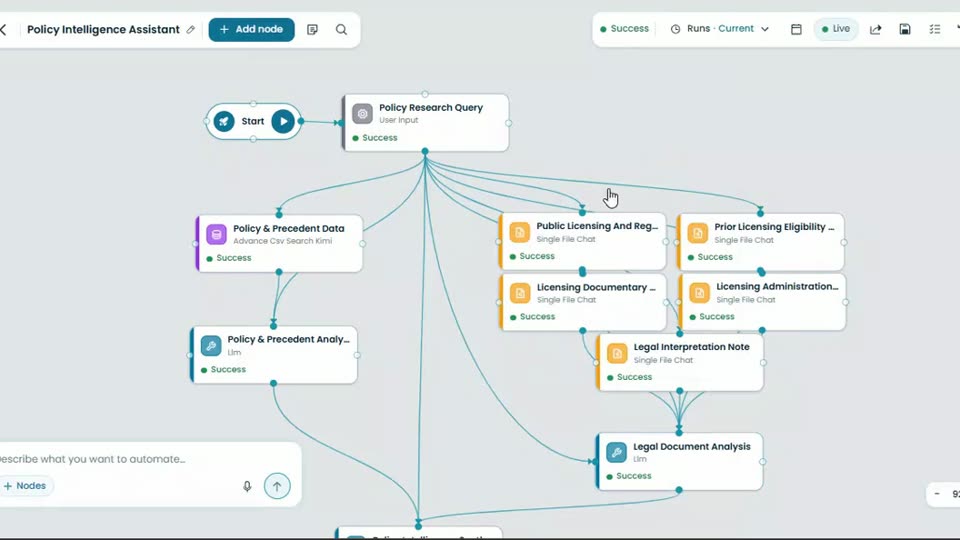
Public sectorA whole policy library, one question awayAsk which positions rely on rules no longer in force. Every claim is cited back to its page.
 1:42
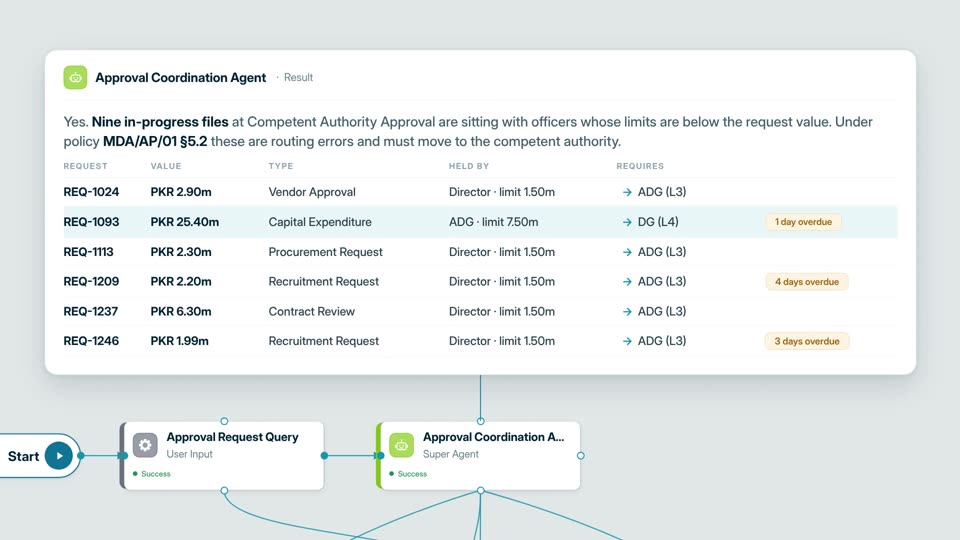
OperationsApprovals routed to the desk that can signThe agent finds files held by officers without the authority to approve them, then escalates each one with the paperwork.
Your AI. Your data. Your control.
Want this on your own data?
Start with a free call with Thomas. We map the work, the data rules, and the right deployment path.
Free. Direct. No pitch deck. Rooted in Middle Tennessee, serving organizations nationwide.