A whole policy library, one question away
Ask which positions rely on rules no longer in force. Every claim is cited back to its page.
The problem
Why this work is slow today.
Policy positions depend on regulations, and regulations change. Finding every position that rests on a repealed rule means reading the whole library. Few departments have the time.
In the demo
What you see, step by step.
Ask the hard question
Which policy positions still rely on regulations that are no longer in force?
The workflow fans out
One step reads the registers of instruments, positions, and precedents. Others read each document in turn.
Analysis and synthesis
Analysis steps work the question against the legal text. A final step gathers every result into one answer.
Publish it as an app
The workflow becomes an assistant any officer can question, with the conversation history kept.
The result
What changes for your team.
The assistant answers point by point and cites each claim to its page. It separates what the act requires from what internal guidance suggests, and it flags where guidance cannot override a legal right.
Who it fits
Policy units
Teams that maintain positions against changing rules.
Regulators and agencies
Departments that answer the same interpretive questions.
Compliance functions
Groups that track obligations across many instruments.
Transcript
The narration, in full.
This Workflow AI use case turns a policy and precedent library into an assistant anyone in the department can question. Every run starts at the User Input node, the bridge between the officer and the workflow, carrying each question in from the front end. Here, the question is, which policy positions still rely on regulations that are no longer in force?
From that one query, the workflow fans out across the whole library at once. A CSV search node reads the registers, the legal instruments, the policy positions, and the precedents. Alongside it, a single file chat node is pointed at each document in turn, from public licensing and prior eligibility to the documentary requirements and the administrative circulars.
The LLM node acts as interpretation and analysis tools, which takes that same query and work it against the legal text. The 3rd LLM node acts as a synthesizer, which gathers every result into one answer, and every node reports success. Appify then turns the workflow into an app, so officers engage with it directly, and with all the policy behind it.
A chatbot app keeps the conversation history, and a description tells anyone opening it what to ask. Published, it becomes the Policy Intelligence Assistant. Ask it for insights on citizen-related policy. It answers point by point and cites every claim back to its page and chunk, so each one can be checked against the source. It separates what the act requires from what internal guidance merely suggests and flags where a lower instrument cannot override a citizen's legal right.
One workflow, one question, and a whole policy library a sentence away.
This demo is produced by ICS Nett and shows FinBlade AI running on sample data. Company names, people, and figures are illustrative. Your deployment runs on your own data, inside your own boundary.
Keep watching
Related demos.
 1:32
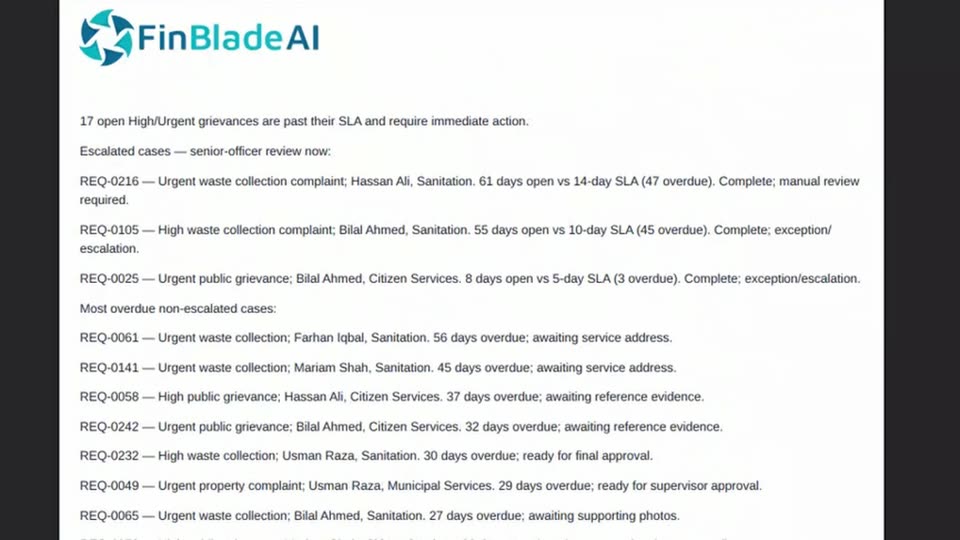
Public sectorCitizen requests, from complaint to decision letterThe agent finds overdue cases, routes each one to approve, request information, or escalate, and sends the right document.
 1:42
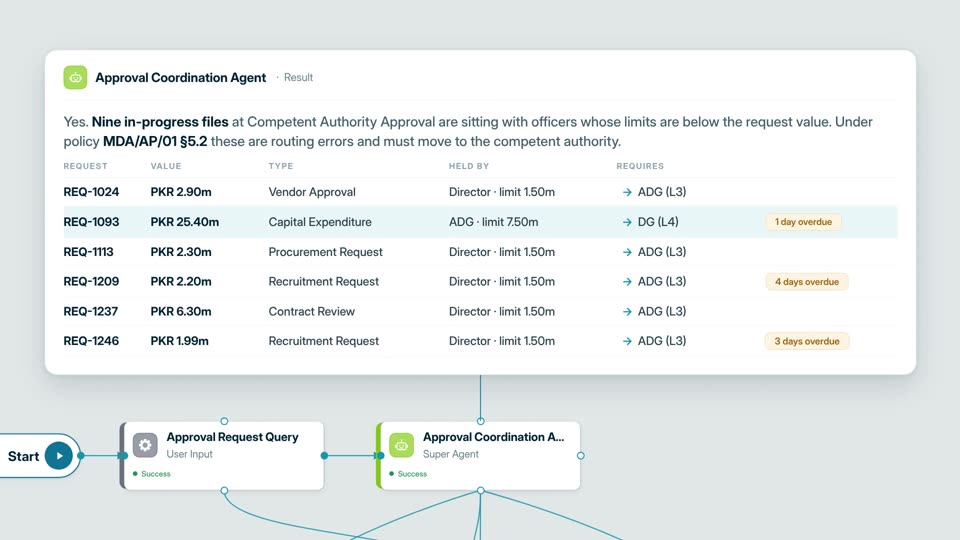
OperationsApprovals routed to the desk that can signThe agent finds files held by officers without the authority to approve them, then escalates each one with the paperwork.
 1:27
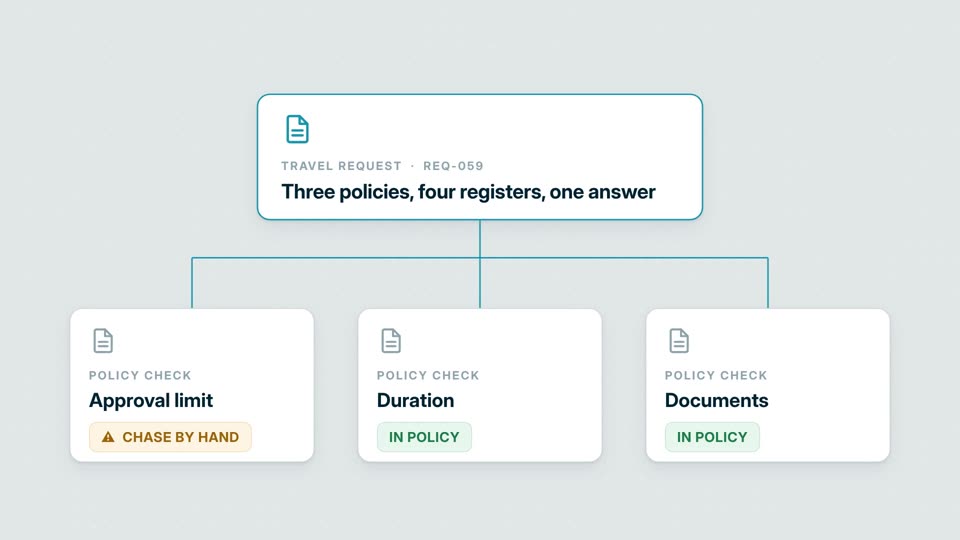
OperationsThree policies, four registers, one answerCan this request be approved? The workflow checks policy and authority, finds the missing document, and routes the exception.
Your AI. Your data. Your control.
Want this on your own data?
Start with a free call with Thomas. We map the work, the data rules, and the right deployment path.
Free. Direct. No pitch deck. Rooted in Middle Tennessee, serving organizations nationwide.